June 17, 2026

Owning a swimming pool in Phoenix comes with unique challenges. Intense summer heat, relentless sunshine, blowing dust, monsoon storms, and nearly year-round swimming all place extra demands on your pool water. Understanding the basics of pool chemistry doesn't have to be intimidating, though. Once you understand what each chemical does and how they work together, maintaining healthy, sparkling water becomes much easier.
Whether you maintain your pool yourself or simply want to better understand what your pool professional is doing each week, this guide will teach you the fundamentals of pool chemistry for Arizona pools.
Pool chemistry is about much more than making the water look clean. Properly balanced water helps:
When chemistry gets out of balance, problems usually snowball. Low sanitizer allows algae to grow. Incorrect pH makes chlorine ineffective. High calcium causes scale that clogs filters, damages heaters, and leaves ugly deposits around your pool.
Arizona pools operate under conditions unlike most of the country.
Phoenix receives over 300 sunny days each year. Ultraviolet light rapidly destroys unstabilized chlorine, making sanitizer disappear much faster than in cooler climates.
Water temperatures frequently exceed 90°F during summer. Warm water accelerates algae growth and increases chlorine demand.
Wind regularly blows dirt, pollen, leaves, and organic material into backyard pools. Every bit of debris consumes chlorine as it decomposes.
Phoenix has naturally hard water. As water evaporates, calcium remains behind, continually increasing hardness levels unless managed properly.
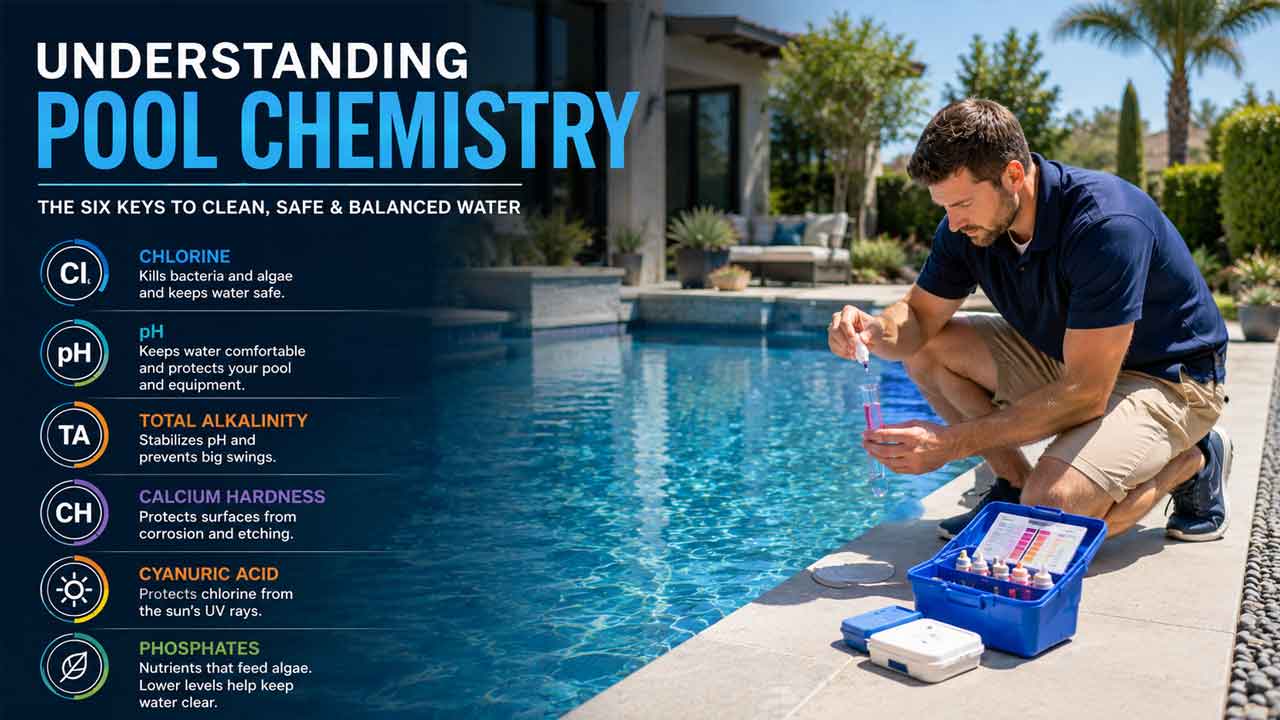
Chlorine is your pool's primary sanitizer. It destroys bacteria, algae, and harmful microorganisms while oxidizing contaminants introduced by swimmers.
If chlorine falls too low:
If chlorine is consistently too high:
Because Phoenix sunlight burns through chlorine quickly, maintaining consistent sanitizer levels is critical.
pH measures how acidic or basic your pool water is.
The ideal range is between 7.4 and 7.6.
High pH can cause:
Low pH can cause:
Arizona pools naturally drift upward in pH because of evaporation and aeration, so acid additions are common.
Think of alkalinity as the stabilizer for your pH.
If alkalinity is too low, pH constantly swings.
If it's too high, pH becomes difficult to lower and scaling becomes more likely.
Keeping alkalinity around 80–100 ppm helps stabilize your water.
Phoenix water already contains significant calcium.
As water evaporates, calcium stays behind and becomes more concentrated.
Excessive calcium causes:
Water replacement may eventually become necessary if calcium becomes excessively high.
Also called conditioner or stabilizer, cyanuric acid protects chlorine from Arizona's intense UV rays.
Without stabilizer, chlorine can disappear within a few hours of sunlight exposure.
Too little stabilizer wastes chlorine.
Too much stabilizer reduces chlorine's effectiveness.
Finding the proper balance is important.
Phosphates are algae food.
They don't create algae by themselves, but elevated phosphate levels allow algae to grow much faster if chlorine ever falls behind.
Keeping phosphates under control gives you an additional safety margin during the hottest months.
Even if you have professional weekly service, it's smart to keep a few basic chemicals available.
Perfect for boosting sanitizer after heavy swimming, rainstorms, or extreme heat.
Used to lower pH, which naturally rises in most Arizona pools.
Raises total alkalinity when necessary.
Raises pH if it falls below the ideal range.
Useful when opening pools or after significant water replacement.
Only needed if calcium tests low, which is uncommon in Phoenix.
Helps oxidize contaminants after pool parties or heavy use.
A reliable drop-based test kit provides much more accurate results than inexpensive test strips.
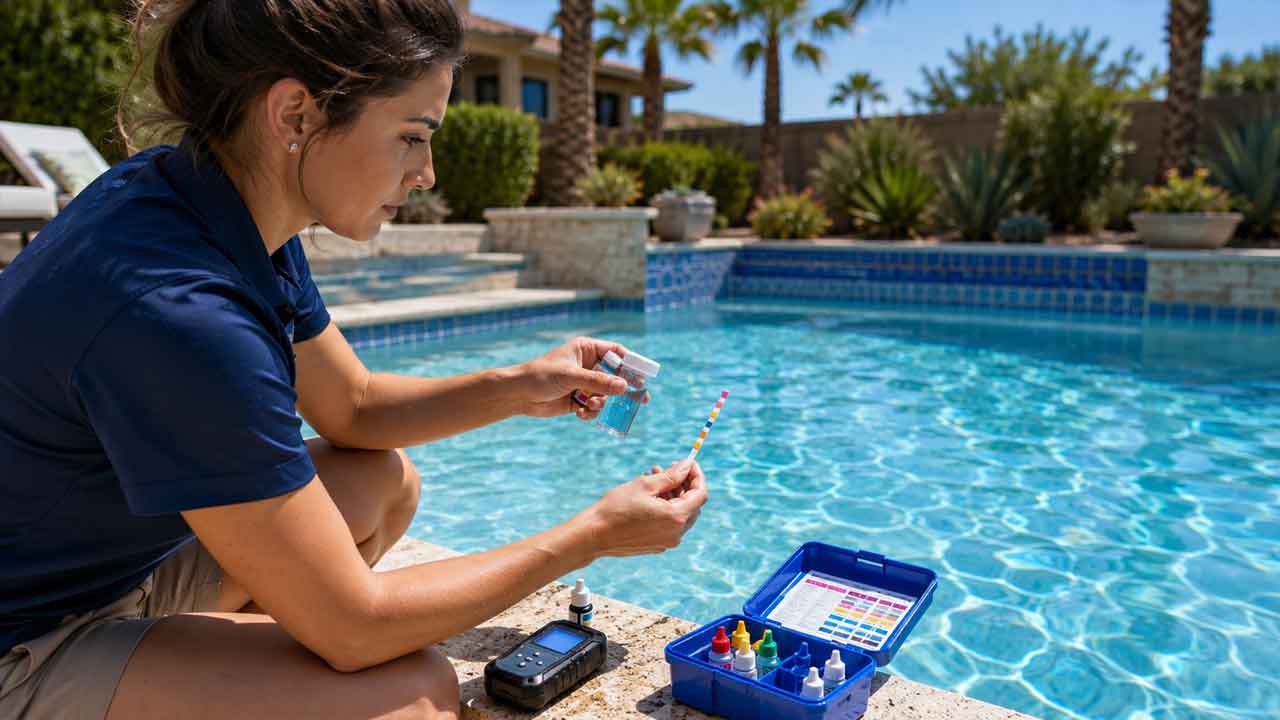
During the swimming season:
After major rainstorms, dust storms, or heavy pool use, it's always a good idea to retest your water.
Watch for these warning signs:
The earlier these issues are addressed, the easier and less expensive they are to correct.
Algae – Microscopic plant growth that turns water green and makes surfaces slippery.
Calcium Hardness – The amount of dissolved calcium in pool water.
Chloramines – Used-up chlorine that causes odor and reduced sanitizing ability.
Cyanuric Acid (CYA) – Stabilizer that protects chlorine from sunlight.
Free Chlorine – Active sanitizer available to disinfect the pool.
Hard Water – Water containing elevated calcium and minerals.
Oxidizer – Chemical that breaks down contaminants and organic waste.
pH – Measurement of acidity or alkalinity.
Phosphates – Nutrients that encourage algae growth.
Pool Shock – A large dose of oxidizer or chlorine used to restore water quality.
PPM – Parts Per Million, the standard unit used for measuring pool chemicals.
Scale – Hard calcium deposits that form on pool surfaces and equipment.
Sanitizer – Chemicals that kill bacteria and harmful microorganisms.
Total Alkalinity – Water's ability to resist pH changes.
One of the biggest mistakes homeowners make is adjusting multiple chemicals at once.
Always:
Pool chemistry works as a system. Changing one value often affects another, so patience is the key to accurate water balance.
Maintaining perfect pool chemistry takes time, experience, and regular testing—especially in the demanding Phoenix climate. If balancing chlorine, pH, alkalinity, calcium, and stabilizer feels overwhelming, or if you'd simply rather spend your weekends enjoying your pool instead of maintaining it, Aqua Harmony Pools is here to help. Our experienced technicians test and balance your water during every service visit, helping prevent algae, equipment damage, and costly repairs before they happen. Contact Aqua Harmony Pools today to schedule professional pool service and enjoy crystal-clear, worry-free water all season long.

Learn the fundamentals of pool chemistry with this easy-to-follow guide for Phoenix homeowners. Discover what each water balance factor does, ideal chemical ranges for Phoenix pools, the products every pool owner should keep on hand, and how proper water chemistry protects your pool, equipment, and swimmers year-round.
.png)

