August 4, 2026
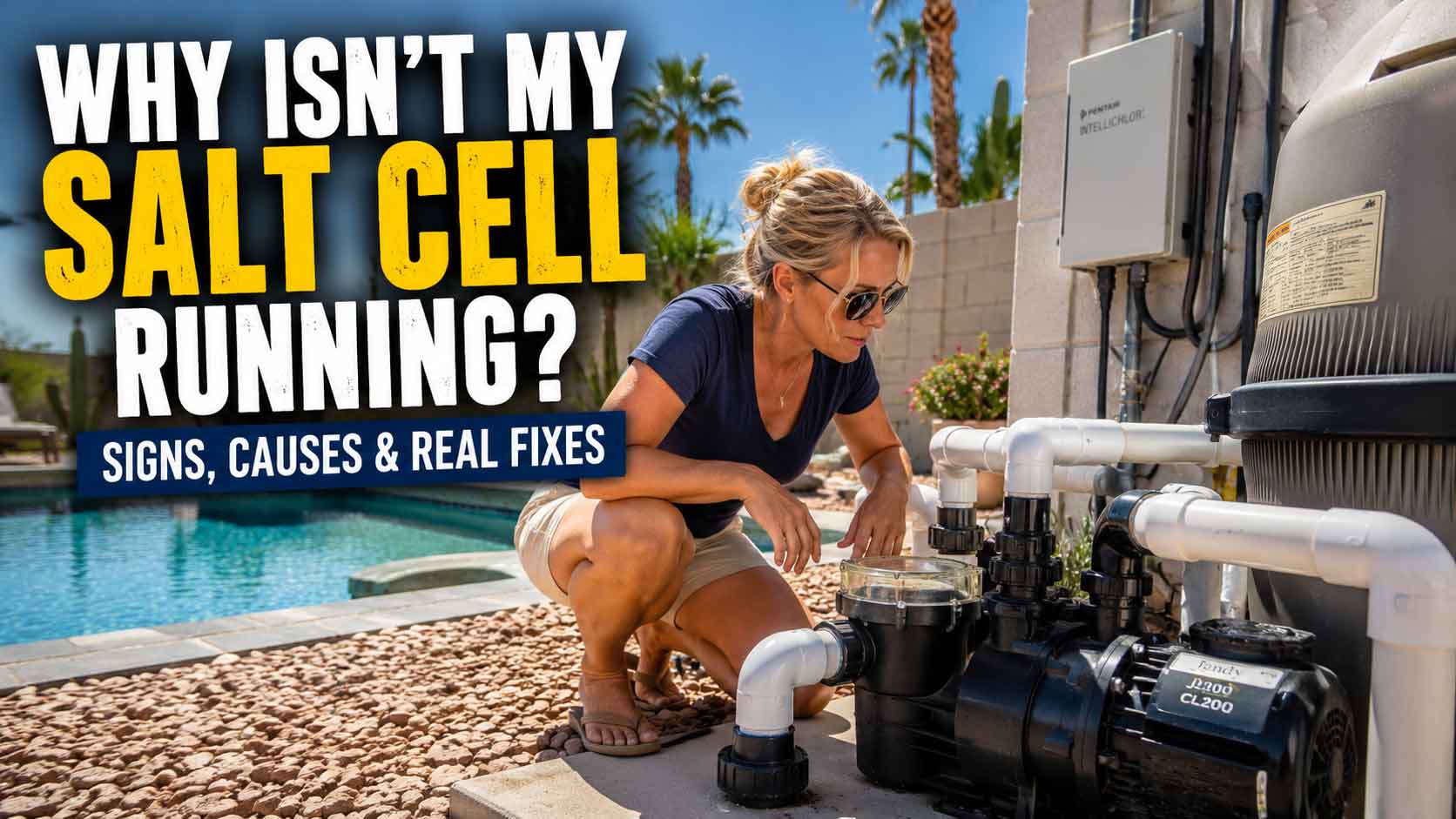
Saltwater pools have become a popular choice for Phoenix homeowners because they can provide consistent chlorination without requiring you to manually add traditional chlorine products as frequently. But a saltwater pool is not a chlorine-free pool. Instead, it relies on a salt chlorine generator, and at the heart of that system is a component that eventually wears out: the salt cell.
If your pool suddenly isn't maintaining chlorine the way it used to, you're seeing warning lights on your salt system, or you've found yourself running the chlorinator at 100% just to keep up, you may be wondering whether your salt cell is reaching the end of its life.
So, how long does a salt cell actually last in Arizona?
For many residential pools, a salt cell can provide several years of service before replacement becomes necessary. Some manufacturers design cells around a finite number of operating hours; Pentair, for example, has historically designed certain salt chlorine generator cells for approximately 10,000 hours of operation. How quickly a homeowner burns through those hours depends heavily on how the pool is operated.
That distinction becomes particularly important in Phoenix.
A salt cell running at 40% output for part of the year is living a very different life than one operating near 100% through a long Arizona swimming season. Water chemistry, calcium buildup, pool size, circulation time and chlorine demand can all affect how hard the system has to work.
Inside a salt chlorine generator, mildly salty pool water passes through an electrolytic cell. The system uses electricity to convert chloride in the water into chlorine, which sanitizes the pool.
The process is convenient, but the cell itself is a wear component.
The metallic coating on its plates doesn't last indefinitely. Every hour the cell actively generates chlorine consumes some of its useful operating life. That's why thinking about a salt cell strictly in terms of calendar years can be misleading.
A lightly used cell might remain productive significantly longer than a heavily loaded one.
Phoenix adds another consideration: hard water.
The City of Phoenix specifically identifies calcium and magnesium as contributors to water hardness in its water-quality reporting. Nearby Chandler reports water hardness ranging from approximately 5 to 20 grains per gallon, averaging about 16.5 grains per gallon. In other words, mineral-rich water isn't an unusual condition in the Valley.
Those minerals matter because calcium scale can accumulate on the plates inside a salt cell.
Manufacturers design modern salt systems to help manage that problem. Jandy's AquaPure system, for example, incorporates automatic polarity reversal designed to reduce scale accumulation, while Pentair incorporates cleaning cycles and diagnostic features into its salt chlorination systems.
Self-cleaning doesn't mean maintenance-free, however.
High calcium hardness combined with elevated pH and warm water can create favorable conditions for scale formation. As Phoenix pool water evaporates, minerals remain behind. When replacement water is added, more dissolved minerals can enter the pool.
Over time, maintaining balanced water chemistry becomes increasingly important.
There isn't one number that applies to every pool.
As a practical expectation, homeowners commonly get multiple swimming seasons from a quality salt cell, with actual life depending heavily on operating hours, chlorine output and water chemistry.
Think of it more like mileage on a vehicle than age on a refrigerator.
Consider two identical cells.
One homeowner operates the system at 40% output for eight hours per day. Another has a larger pool with significant sun exposure and runs the same cell near maximum output for considerably longer periods.
Even though both cells were installed on the same date, they aren't accumulating equivalent operating wear.
Some current systems actually help make this easier to understand. Pentair's IntelliChlor products include diagnostic capabilities that can report system status and track remaining cell-life information rather than forcing technicians to judge condition solely from the installation date.
This is one reason we don't recommend replacing a salt cell simply because someone says, "It's five years old."
Age matters. Performance matters more.
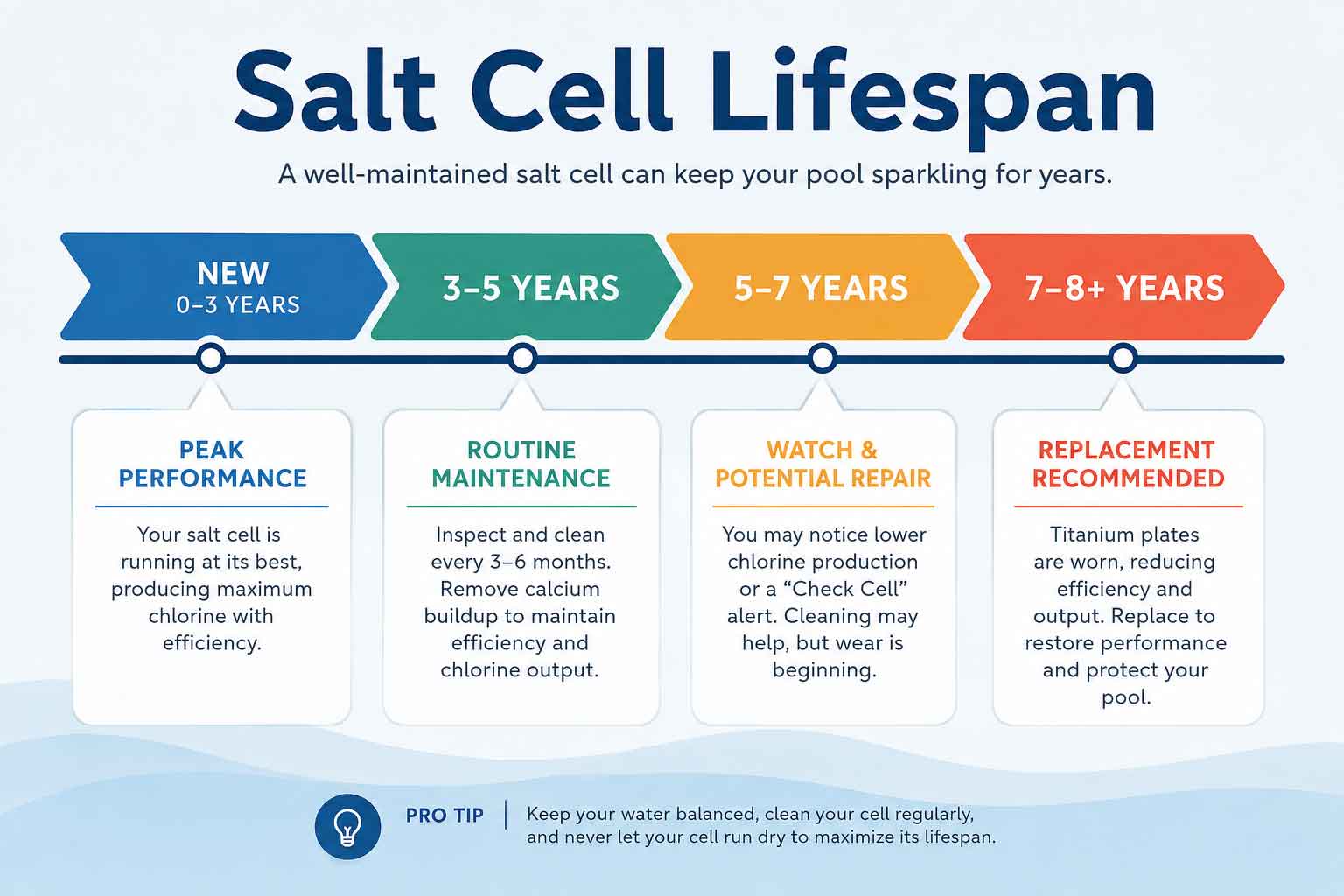
One of the most common signs of an aging salt cell is gradually declining chlorine production.
Maybe the pool used to maintain its target chlorine level with the generator set at 40%, but now you've increased it to 60%, then 80%, and eventually 100%.
That's worth investigating.
Other symptoms can include warning or service lights, incorrect salt readings, difficulty maintaining free chlorine, visible calcium deposits inside the cell, or diagnostic values that don't match what the manufacturer expects.
But here's the important part:
Low chlorine does not automatically mean you need a new salt cell.
Before replacing one of the more expensive components on your equipment pad, the entire system should be evaluated.
A pool that's struggling to maintain chlorine could also have insufficient circulation, an undersized chlorinator, incorrect salt concentration, excessive organic demand, poor water balance or another equipment problem.
Salt readings deserve particular attention.
A salt system might report one concentration while an independent water test shows something substantially different. Modern generators have increasingly sophisticated salinity sensors—Pentair, for example, now advertises improved conductivity sensing and extensive onboard diagnostics on newer IntelliChlor systems. Nevertheless, verifying the actual water chemistry remains an important part of diagnosing the system.
Don't start adding bag after bag of salt simply because the controller says the salt level is low.
Confirm it first.
One of the biggest money-saving distinctions a Phoenix pool owner should understand is the difference between a dirty salt cell and a depleted salt cell.
They're not the same thing.
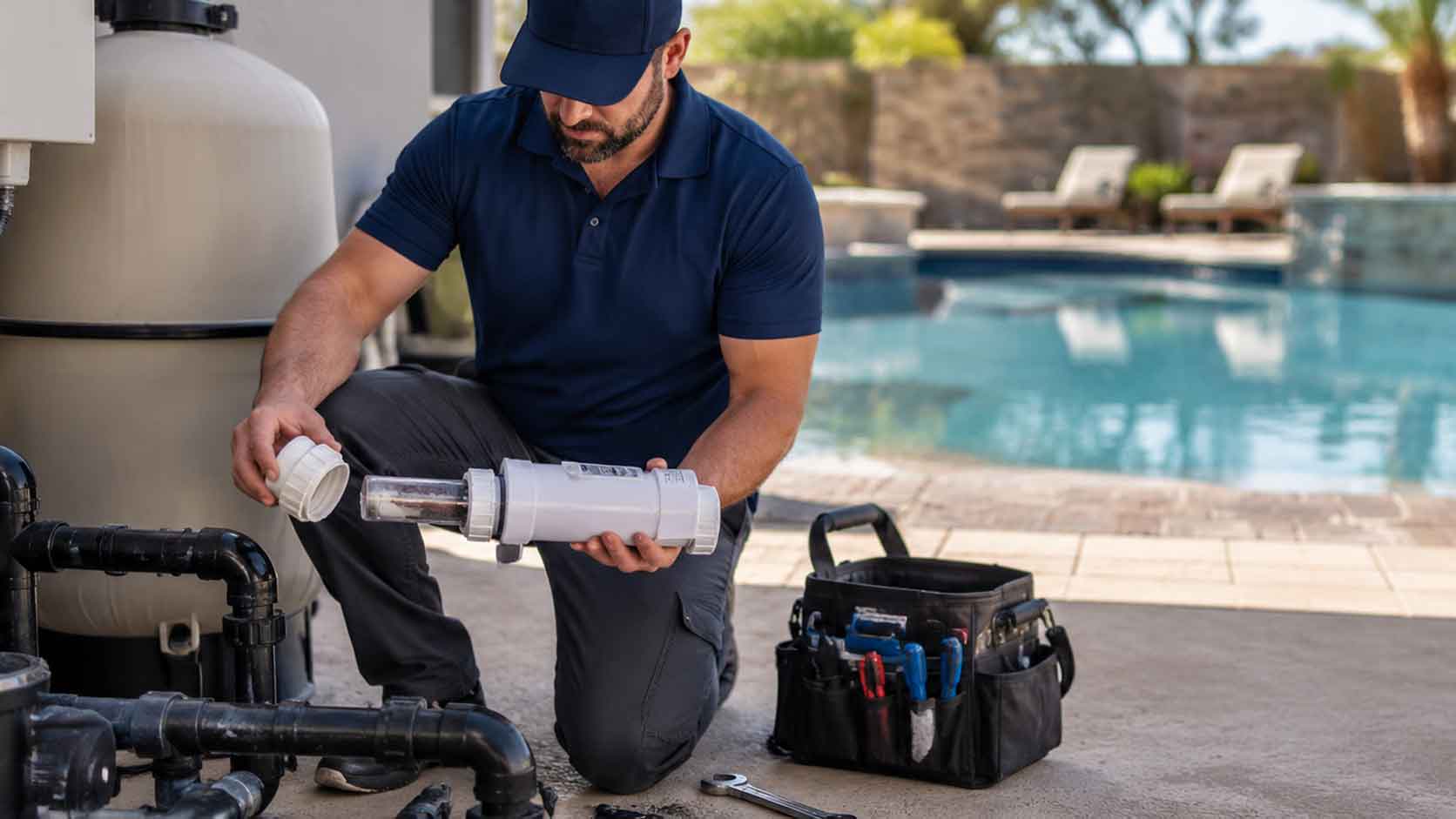
Calcium scale can accumulate between the plates and interfere with chlorine production. If the cell itself is still healthy, removing the buildup may restore normal performance.
Manufacturers consequently recommend periodic cell inspection and cleaning when necessary. Hayward documentation, for example, instructs homeowners to inspect cells for calcium deposits and provides procedures for cleaning them.
But that doesn't mean the cell should automatically receive an acid bath every few weeks.
In fact, Hayward documentation for some AquaRite cells recommends mild acid washing only when deposits cannot otherwise be removed.
That's an important distinction in Arizona.
The goal should be to prevent excessive scale through good water management, not continually allow heavy deposits to form and compensate by aggressively acid-cleaning the cell.
If a properly cleaned cell still can't generate adequate chlorine, diagnostic readings indicate the cell has exhausted its useful life, and the rest of the system is operating correctly, replacement becomes the logical next step.
This is where homeowners can experience some sticker shock.
Salt cells are no longer inexpensive replacement components.
The exact price depends heavily on manufacturer, cell capacity, warranty, whether you choose OEM or aftermarket equipment, and whether additional components need replacement.
As of August 2026, retail pricing provides a useful illustration. A current Pentair IntelliChlor Plus40 replacement cell rated for pools up to 40,000 gallons was listed around $1,819 by Leslie's, while another national retailer showed pricing in roughly the same range. A Jandy PLC1400 AquaPure replacement kit for pools up to 40,000 gallons was listed around $1,350 by another pool-equipment retailer.
Aftermarket products can cost considerably less. For example, compatible replacements for some major-brand systems are available hundreds of dollars below current OEM pricing.
Those are equipment prices, however—not necessarily what a complete professional replacement will cost at your home.
A service visit may involve diagnosis, verifying salt and water chemistry, inspecting electrical components and flow, removing the old cell, installing the replacement, checking for leaks, configuring the controller and confirming proper chlorine production.
There is also a major difference between replacing only the cell and replacing significant portions of an aging salt system.
If the power center, control board, flow sensor or associated equipment is also failing, repairing a very old chlorinator piece by piece may no longer make financial sense.
That's why we prefer diagnosis before parts replacement.
When an OEM cell approaches four figures—or significantly more—the price difference offered by aftermarket cells can certainly get a homeowner's attention.
But price alone shouldn't make the decision.
You want to compare chlorine production capacity, compatibility with the existing controller, warranty coverage, expected life and manufacturer support.
A replacement that saves several hundred dollars today isn't necessarily less expensive if it has to be replaced substantially sooner.
The calculation homeowners should really make is cost per year of reliable operation.
If a $1,400 salt cell provides six years of dependable service, that's roughly $233 per year before installation and maintenance.
If a $700 alternative lasts only three years, your effective annual equipment cost is almost identical.
Reliability matters too. Losing chlorine production during a 110-degree Phoenix summer isn't an ideal time to discover the inexpensive replacement wasn't such a bargain.
Pool size also deserves consideration when replacing a salt cell.
A manufacturer's maximum pool capacity shouldn't automatically be interpreted as the ideal size for every pool under that limit.
Imagine a chlorinator advertised for pools up to 20,000 gallons installed on an 18,000-gallon Phoenix pool.
It may technically be within the manufacturer's capacity, but the system can spend a considerable amount of time operating near the upper end of its output during periods of heavy chlorine demand.
Installing a higher-capacity compatible cell can sometimes allow the system to meet the pool's chlorine demand at a lower output setting.
That doesn't mean "bigger is always better." The cell must be compatible with the controller and properly configured.
But when we evaluate replacement options, we look at how the pool is actually being used, not simply the gallon rating printed on the equipment.
There is no maintenance routine that can make a salt cell last forever, but proper water management can help prevent unnecessary problems.
Keeping pH and calcium conditions under control is particularly important in the Phoenix area. Inspect the cell periodically rather than waiting for severe buildup. Maintain proper circulation. Verify salt levels with reliable testing instead of responding blindly to a controller warning.
And perhaps most importantly, pay attention when the amount of chlorine output required begins changing.
If your salt generator maintained the pool comfortably at 40% or 50% last season but suddenly needs to run at 100%, don't simply leave it there indefinitely.
Something changed.
Maybe chlorine demand has increased. Maybe the water chemistry needs attention. Maybe the cell is scaled. Maybe the sensor is providing an inaccurate reading.
Or maybe the cell really is reaching the end of its useful life.
Finding out which one it is can prevent you from spending $1,000 or more on a component you didn't actually need.
Salt chlorine generators are remarkably convenient when they're properly sized, maintained and operated. But the salt cell is ultimately a consumable component, and every Arizona salt pool owner will eventually face the question of replacement.
The key is knowing when replacement is actually necessary.
At Aqua Harmony Pools, we don't believe in simply swapping expensive parts until a problem disappears.
If your Phoenix-area pool isn't producing enough chlorine, the salt reading doesn't seem right, the generator is displaying errors or you're wondering whether an aging salt cell still has life left in it, we can evaluate the system and determine what's actually happening.
Sometimes the answer is a new salt cell.
Sometimes it's cleaning, chemistry, circulation or another component entirely.
Either way, you shouldn't have to diagnose it by yourself.
Contact Aqua Harmony Pools today for professional saltwater pool diagnostics, maintenance and equipment replacement throughout the Phoenix area. We'll help you determine what your pool actually needs—and make sure your salt system is ready for another Arizona swimming season.

Learn how long salt cells typically last in Arizona, what causes them to wear out, and how Phoenix’s hard water and demanding summer conditions can affect their lifespan. We’ll also cover common signs of salt cell failure, cleaning versus replacement, diagnostic checks, replacement costs, and ways to help your salt system last longer.
.png)

