October 17, 2026


A white line around the pool can make otherwise clean water look neglected. Maybe it started as a faint haze on the tile. Now there is a rough, chalky band that brushing does not seem to remove, and the same buildup keeps returning after you clean it.
For Phoenix homeowners, calcium buildup is a familiar frustration. But treating it as nothing more than dirty tile misses an important part of the problem.
White scale on pool tile is often a mineral deposit associated with evaporation and water balance. Removing the deposit addresses its appearance; understanding why it formed helps reduce the chances of it coming back.
Before reaching for a scraper, an abrasive stone or a stronger cleaner, it helps to know what you are looking at, what the water is doing and which cleaning methods are appropriate for your pool.
One common cause is calcium carbonate scale: dissolved minerals leave the water and form a hard deposit on a surface.
At the tile line, it may appear as a thin white film, an uneven crust or a rough band near the normal water level. Deposits can also show up around spillways, water features, fittings and other areas that are repeatedly wet and then allowed to dry.
However, not every white mark is the same material or has the same cause.
Grout residue, deposits associated with moisture moving through masonry, surface deterioration and other mineral compounds can resemble ordinary scale. A chalky line on glazed ceramic tile and a white deposit emerging through natural stone may require very different treatment.
Location, texture, the material underneath and the history of the problem all matter. A photograph can help a technician understand what you are seeing, but appearance alone may not provide a complete diagnosis.
That distinction is especially important before choosing a chemical or abrasive cleaning method.
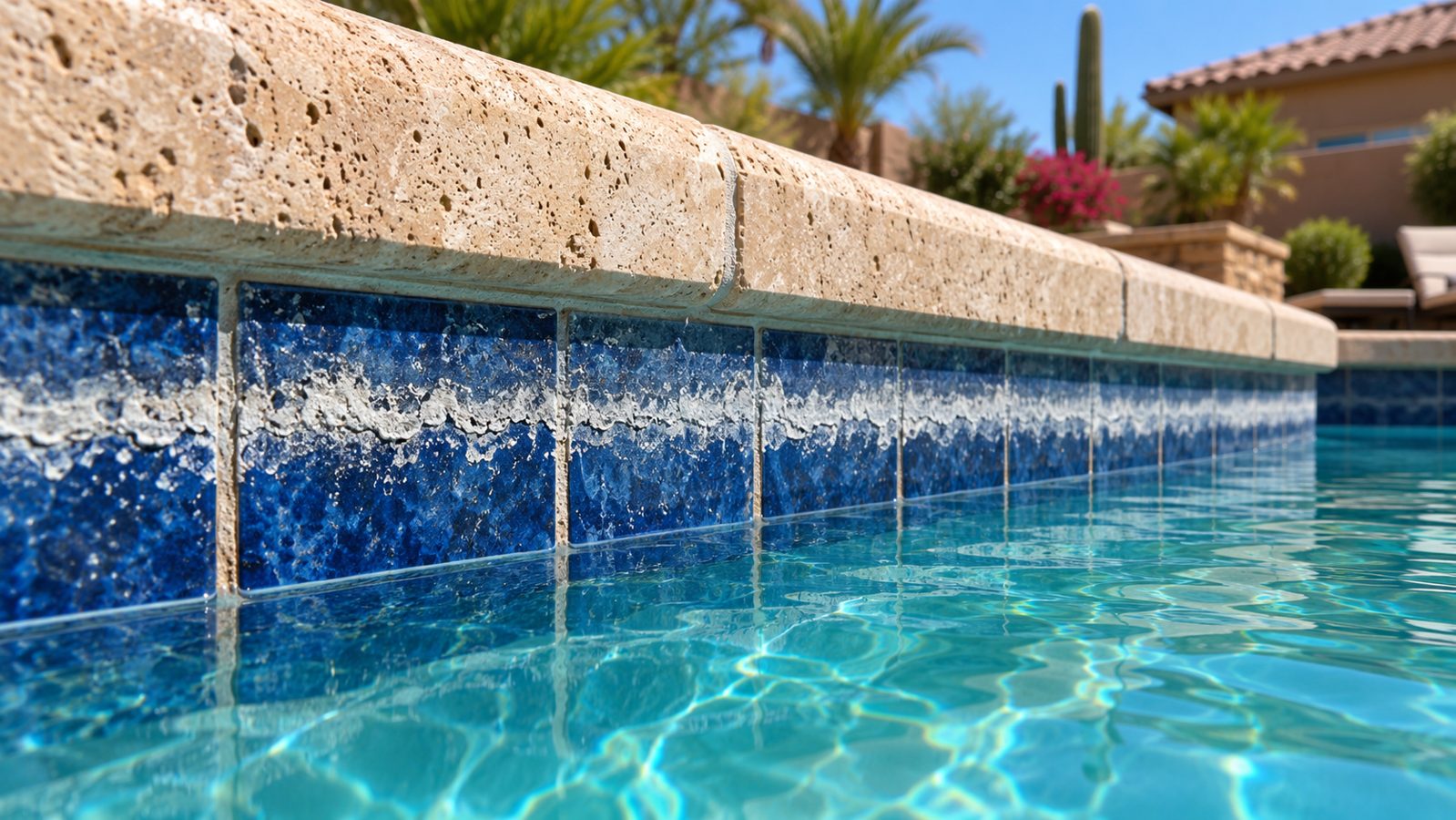
Phoenix pool owners are working with mineral-rich fill water. The City of Phoenix identifies calcium and magnesium as contributors to local water hardness.
Those minerals enter the pool when you fill it and when you replace water that has been lost.
Evaporation creates an ongoing challenge. Water leaves the pool, but most dissolved minerals stay behind. Topping off the pool adds replacement water along with the minerals it contains. Over time, that cycle can increase the concentration of dissolved materials.
Water splashing onto tile, stone or a spillway can leave deposits as it dries, too. This localized wetting and drying helps explain why a waterline can look worse than other areas of the pool.
But hard water is only part of the explanation.
Two pools filled from the same supply can develop very different scaling problems because their pH, alkalinity, calcium hardness, temperature and maintenance histories differ. A pool that repeatedly drifts into scale-forming conditions may accumulate deposits faster than one managed with those factors in mind.
When homeowners see scale, the immediate assumption is often that the calcium reading must be too high.
It may be elevated. But calcium hardness should not be evaluated by itself.
The water's tendency to deposit or dissolve calcium carbonate depends on several conditions working together. That is why pool professionals use tools such as the Langelier Saturation Index, or LSI, to evaluate scale-forming tendencies.
Think of it as a way to look at the relationship between the readings rather than deciding that each individual number tells the whole story.
Higher pH can increase scaling potential. Water temperature and carbonate alkalinity also influence the balance. Stabilizer and dissolved solids affect the calculation, so reliable test results and the correct inputs are important.
A single pH test taken after chemicals were added also does not tell you what the pool experienced over the previous week.
If pH repeatedly climbs between service visits, the water may spend time in conditions that encourage scale even though the reading looks acceptable immediately after an adjustment. Our article on why Phoenix pools need frequent acid adjustments explores that related issue.
The goal is consistent water management, not chasing one reading while ignoring everything around it.
A mineral deposit by itself does not tell you whether the water has adequate sanitizer or appropriate swimming conditions. The reverse is also true: sparkling water and clean-looking tile do not prove that the pool chemistry is correct.
Scale is primarily a surface and water-balance concern, although rough deposits can be uncomfortable on skin and heavy accumulation can affect equipment.
Sanitizer, pH, water clarity and the overall condition of the pool still need to be checked independently. A saturation-index calculation is not a substitute for those checks.
Our Phoenix homeowner's guide to pool chemistry explains how the main readings fit into an overall maintenance routine.
The answer depends on the deposit and the surface.
Start by identifying whether the tile is glazed ceramic, porcelain, glass or another material. Nearby natural stone, grout, metal trim and sealants also need consideration. A cleaner that is appropriate for one surface may damage another.
Light residue may respond to a suitable tile cleaner and a nonabrasive pad approved for that material. More established deposits can require a different approach, including professional cleaning methods selected for the specific finish.
Do not assume that a tool labeled for swimming pools is suitable for every pool surface.
Pumice, aggressive scrubbing pads, metal scrapers and wire brushes can scratch or dull some materials. Acidic products can affect grout, stone and decorative finishes. Pressure and blasting media also need to be matched to the surface rather than chosen simply because they remove deposits quickly.
Follow the tile and cleaning-product manufacturers' instructions, including any test-area recommendation. Keep cleaners separate from other pool chemicals, and do not improvise mixtures.
Orenda's guidance on carbonate scale removal discusses both water balance and surface cleaning. It also notes that organic material can complicate deposits around the tile line.
That helps explain why a dirty waterline may involve more than one type of buildup. Sunscreen residue and other organic material can accumulate alongside mineral deposits, making the band look darker or more stubborn.
A proper assessment should identify what needs to be removed without sacrificing the surface underneath it.
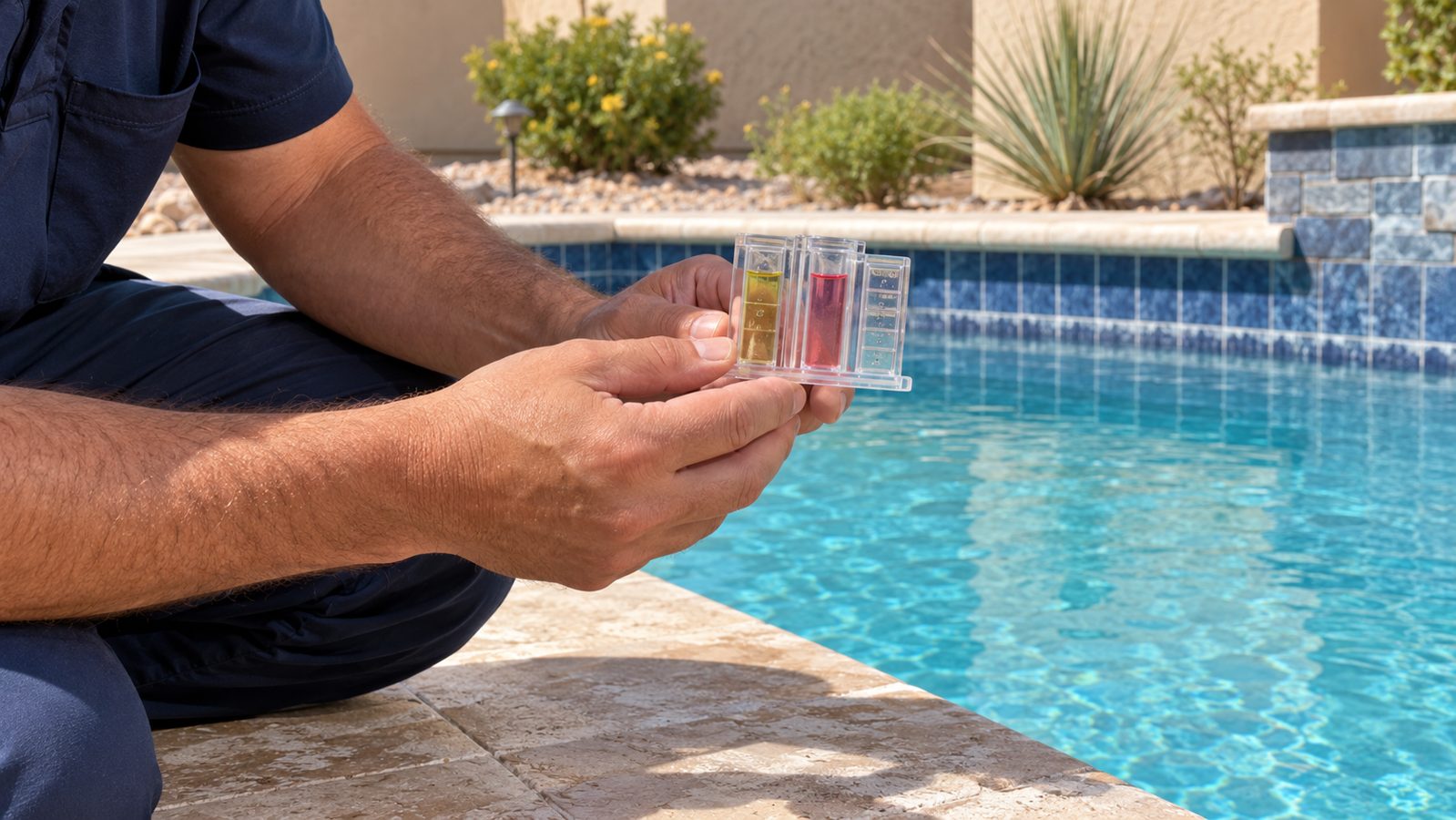
Adding acid can lower pH and change the water's calcium carbonate balance. It does not physically remove dissolved calcium from the pool.
That difference is easy to overlook.
A pool can have a lower pH after treatment while still containing essentially the same calcium. Under carefully managed conditions, some carbonate deposits may dissolve back into the water. That also does not mean the calcium has left the pool.
Trying to strip scale by keeping the water excessively aggressive can create another problem: damage to cement-based finishes, grout or equipment.
Likewise, a scale-control product should not automatically be understood as a product that lowers calcium hardness. Products work differently, and their role needs to be evaluated alongside the water test and the manufacturer's instructions.
The objective is to manage the water and choose an appropriate removal method, not to keep adding stronger chemicals until the white line disappears.
Not necessarily.
A white tile line alone does not establish that the entire pool needs new water. Before discussing water replacement, test the existing pool and the available replacement water.
If dissolved calcium or other accumulated materials have reached a point where routine management is impractical, partial water replacement may be one option. But the benefit depends partly on how the fill water compares with what is already in the pool.
Replacing hard pool water with equally hard fill water will not deliver the same result as replacing it with a substantially lower-hardness source.
The pool's construction, groundwater conditions, weather, discharge requirements and equipment also influence what can be done safely. Draining should be planned with a qualified pool professional rather than treated as a routine first step.
Specialized water-treatment options may be available in some markets, but suitability and availability need to be assessed for the individual pool.
If you are seeing scale on the tile, it is worth looking beyond the waterline.
Salt chlorine generator cells and other equipment can develop calcium deposits under the right conditions. The amount visible on the tile does not reliably tell you what is happening inside a component.
If a salt system is producing less chlorine, displaying warnings or requiring frequent cleaning, diagnosis should come before replacement. Our guide to salt cell lifespan and replacement in Phoenix explains why a scaled cell and a worn-out cell are different problems.
Equipment inspections are also part of understanding whether circulation and operating conditions are supporting the maintenance plan. Aqua Harmony Pools provides pool equipment diagnostics and repairs when symptoms suggest something needs attention.
Removing visible scale is a useful starting point. Reducing recurrence takes an ongoing routine.
Track water chemistry over time, including calcium hardness and temperature. Pay attention to pH trends rather than waiting for a visible deposit. Clean the waterline with methods appropriate for the material, and inspect spillways and repeatedly splashed areas.
Keep records of major water additions, treatments and recurring problems. If the pool is regularly topped off, remember that the fill water is part of the chemistry picture.
As the weather cools, reassess the balance instead of carrying the same treatment assumptions through every season. Orenda's explanation of water temperature and calcium balance shows why colder water can shift the saturation index. A plan intended to control summer scaling should be reviewed as conditions change.
Consistent weekly pool maintenance helps make those changes easier to spot before a faint line turns into a larger problem.
You should not have to choose between living with a chalky tile line and experimenting with cleaners that might damage the pool.
Start with the surface, the deposit and a complete water test. Understanding those three things makes it easier to choose a practical next step and address the conditions contributing to the buildup.
Seeing recurring white scale on your Phoenix pool tile? Contact Aqua Harmony Pools or call (480) 542-7341 to discuss your water chemistry and maintenance needs. We can help evaluate the pool's condition and recommend the next steps for managing the problem.

White scale on pool tile is a familiar problem in Phoenix, but removing the deposit is only part of the solution. Learn how hard water, evaporation and water balance contribute to calcium buildup, what to consider before cleaning, and how consistent maintenance can help reduce recurrence.