July 23, 2026
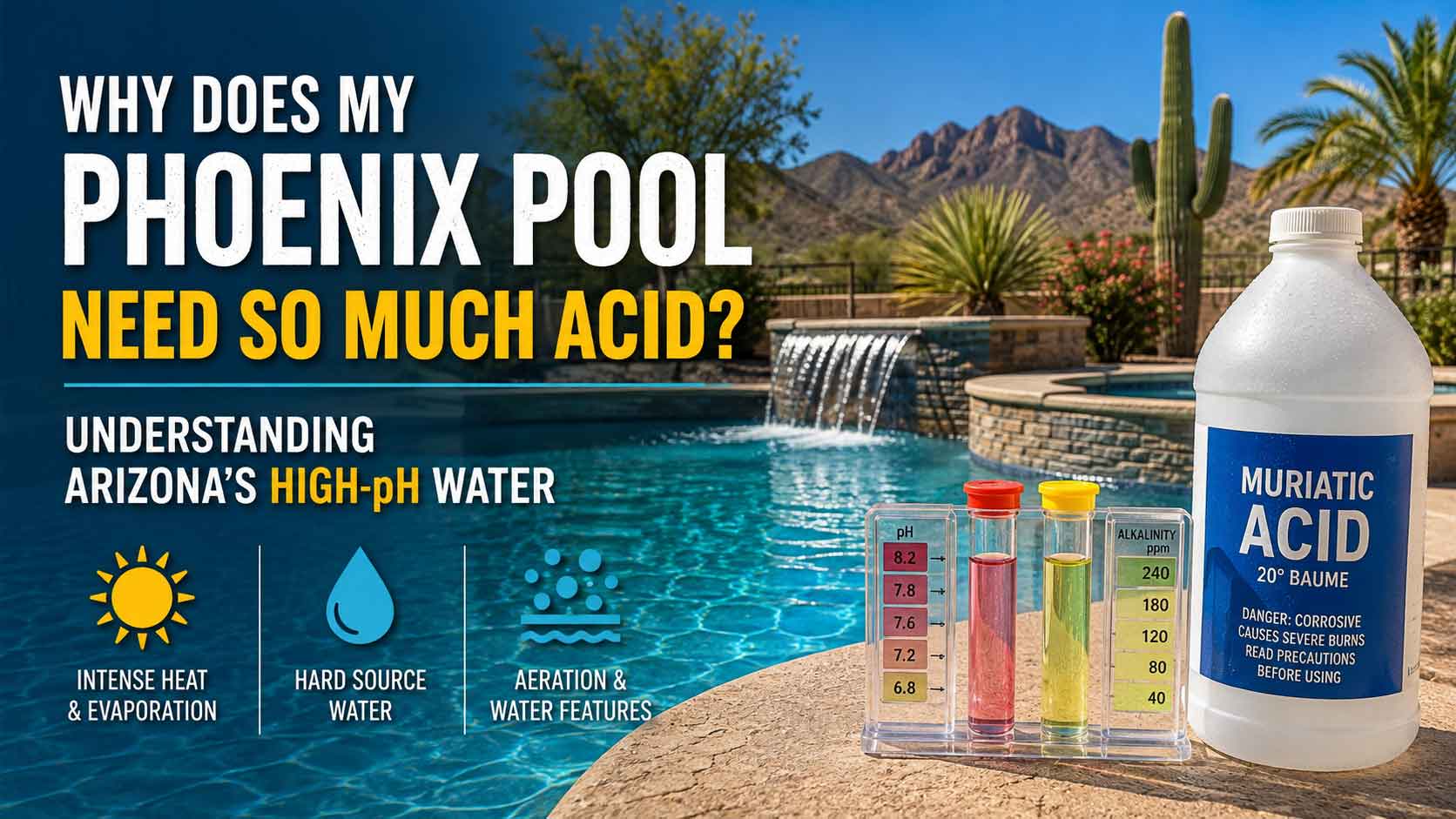
If it feels like you're constantly adding muriatic acid to your swimming pool, you're not imagining things. For Phoenix pool owners, rising pH and frequent acid demand are among the most common water chemistry challenges we encounter.
Part of the reason is simply where we live.
Phoenix has hard, mineral-rich source water, intense evaporation, long swimming seasons and plenty of pools equipped with spas, waterfalls, bubblers and salt chlorine systems. Put those factors together and you have an environment where keeping pH under control can require considerably more attention than homeowners might expect.
Some acid demand is perfectly normal. But if you're pouring acid into your pool week after week and the pH immediately climbs again, there may be more happening than simply "Arizona has hard water."
Understanding why your pH keeps rising can help you maintain better water quality, prevent calcium scale and protect some very expensive pool equipment.
The water coming out of your hose isn't chemically neutral.
According to the City of Phoenix's 2025 Water Quality Report, alkalinity in the city's distribution system ranged from approximately 121 to 167 parts per million, while total hardness ranged from 172 to 302 ppm. The city itself classifies Phoenix water as hard and notes that hard water can contribute to scaling in plumbing and water-heating equipment.
For a swimming pool, those characteristics matter.
Total alkalinity essentially describes the water's ability to resist changes in pH. That's useful to a point. However, higher alkalinity can also create conditions where pH continually drifts upward as carbon dioxide leaves the water.
That process happens in every swimming pool, but certain characteristics of Phoenix pools can accelerate it.
Think about what happens when several inches of water disappear from your swimming pool during a hot Arizona summer.
The water evaporates.
The calcium, minerals and other dissolved solids largely don't.
Then you refill the pool with more hard Phoenix water, introducing another supply of minerals. Repeat that process throughout the season and the concentration of calcium and dissolved material in the pool can continue increasing.
This is one reason maintaining water balance in Phoenix isn't simply a matter of checking chlorine once in a while.
A pool can look perfectly clear while its chemistry is gradually moving toward conditions that encourage scale.
One of the most frustrating experiences for a pool owner goes something like this:
You test the pool and discover the pH is high. You add acid. The pH comes back down.
A few days later, it's high again.
You add more acid.
Then you do it again the following week.
What you're seeing may be related to the relationship between alkalinity, carbon dioxide and pH.
Pool water contains dissolved carbon dioxide associated with the carbonate chemistry that contributes to total alkalinity. As carbon dioxide escapes from the water into the atmosphere, the pH rises.
Adding acid lowers the pH and also gradually reduces total alkalinity. But if the underlying conditions causing rapid carbon dioxide loss haven't been addressed, the pH can simply begin climbing again.
That's why continually adding acid isn't always the complete solution.
One of the easiest causes of rising pH to overlook is aeration.
Anything that aggressively moves water through the air can increase the rate at which carbon dioxide escapes.
That includes waterfalls, deck jets, bubblers, sheer descents, raised spa spillways, fountains, negative-edge systems and even the jets in an attached spa.
These features may be some of the best-looking parts of your backyard, and there's certainly no reason you shouldn't enjoy them. But homeowners should understand that running highly aerating features for extended periods can influence water chemistry.
A raised spa that continuously spills into the pool, for example, isn't just circulating water. It's constantly aerating it.
If your pool already has relatively high total alkalinity, that additional aeration can contribute to faster pH rise.
The answer isn't necessarily to shut off your water features. It may simply mean adjusting how they're scheduled and maintaining the pool's chemistry appropriately for the way the pool is actually operated.
Salt chlorine generators are extremely popular because they provide a convenient way to produce chlorine automatically.
But "saltwater" doesn't mean "maintenance-free."
Salt chlorine systems can be associated with persistent upward pH pressure, particularly when combined with higher alkalinity and aeration. The chlorine-generation process creates gas at the cell and contributes to conditions that can accelerate carbon dioxide loss from the water.
That means a Phoenix pool with a salt system, raised spa and high-alkalinity fill water may naturally require more pH management than a homeowner expects.
There is another reason controlling the chemistry is important.
High-pH, scale-forming water can cause calcium deposits to accumulate on the salt cell itself. Eventually, that buildup can reduce performance and require more frequent cell cleaning.
So if you're constantly cleaning calcium from your salt cell while simultaneously fighting rising pH, those problems may be connected.
If your Phoenix pool was recently built or resurfaced with a cementitious interior, there's another potential explanation for unusually high pH.
Fresh plaster undergoes a curing process that affects the surrounding water chemistry. During the startup period, pH can rise quickly and require considerably more frequent monitoring and adjustment.
That makes the first weeks and months after a new plaster installation particularly important.
Poorly managed startup chemistry can contribute to scaling, discoloration, surface problems and other issues that may affect the appearance and longevity of the new finish.
If your pool suddenly began requiring much more acid immediately after resurfacing, that doesn't necessarily mean something went wrong. Increased acid demand can be part of the startup process.
What matters is whether that chemistry is being properly monitored and managed.

There's no honest answer that says every Phoenix pool should use a certain number of ounces of muriatic acid per week.
Every pool is different.
A 10,000-gallon chlorine pool with no water features isn't going to behave exactly like a 25,000-gallon salt pool with an attached raised spa, waterfall and multiple bubblers.
Acid demand can be influenced by pool volume, total alkalinity, calcium hardness, source water, evaporation, temperature, sanitizer type, surface material, water features, salt chlorine generation and how frequently fresh water is added.
That's why we prefer looking at the overall behavior of the water rather than simply asking how much acid you've purchased.
Some recurring acid demand can be completely normal in Phoenix.
Rapid, persistent pH rise despite frequent chemical adjustments deserves a closer look.
Ignoring rising pH isn't a particularly good solution.
The CDC recommends maintaining residential swimming pools between pH 7.0 and 7.8 and notes that as pH rises, chlorine's ability to kill germs decreases, particularly above pH 8.0. Maintaining proper pH also helps protect swimmers and pool equipment.
In Phoenix, however, one of our biggest concerns with improperly balanced water is calcium scale.
When calcium-rich water becomes increasingly scale-forming, you may begin noticing white deposits around the waterline, calcium buildup on tile, rough surfaces or deposits on equipment.
The problems you can't immediately see can be more concerning.
Scale can accumulate inside heaters, plumbing and salt chlorine generator cells. Heat exchangers are particularly sensitive to improper water chemistry because scale creates a layer between the water and the equipment designed to transfer heat.
Over time, a chemistry problem that seemed like nothing more than an annoying white line around the tile can become an equipment problem.
One mistake homeowners frequently make is trying to manage their swimming pool based on one test result.
They see high pH and add acid.
They see low chlorine and add chlorine.
But pool chemistry doesn't work as a collection of completely independent numbers.
pH, total alkalinity, calcium hardness, water temperature, cyanuric acid and total dissolved solids all interact.
Pool professionals frequently evaluate those relationships using the Langelier Saturation Index, or LSI. Rather than looking at pH alone, the LSI provides a more complete picture of whether water is trending toward scale-forming or potentially corrosive conditions.
That's particularly useful in Arizona because calcium levels can become elevated as years of evaporation and refilling concentrate minerals in the pool.
Two pools with exactly the same pH can have very different water-balance conditions depending on everything else happening in the water.
The goal isn't simply to get a pH test to display the "right" number.
The goal is balanced water.
If your pool requires acid regularly, don't immediately assume there's a problem. Phoenix pools frequently require routine pH adjustment.
But unusually heavy or increasing acid demand is worth investigating.
The underlying cause could be high total alkalinity, high-alkalinity makeup water, excessive aeration, a spa spillover running for long periods, salt chlorine generation, new plaster curing or simply a pool whose overall water balance has gradually changed.
In older pools, years of evaporation and refilling can also leave the water with very high calcium hardness or total dissolved solids.
At that point, chemical adjustments alone may not address the entire problem.
Depending on the actual test results, correcting the water may involve changing equipment schedules, adjusting alkalinity, modifying how water features operate, recalibrating chemical automation or replacing a portion of the pool water.
The important part is identifying the cause before deciding on the treatment.
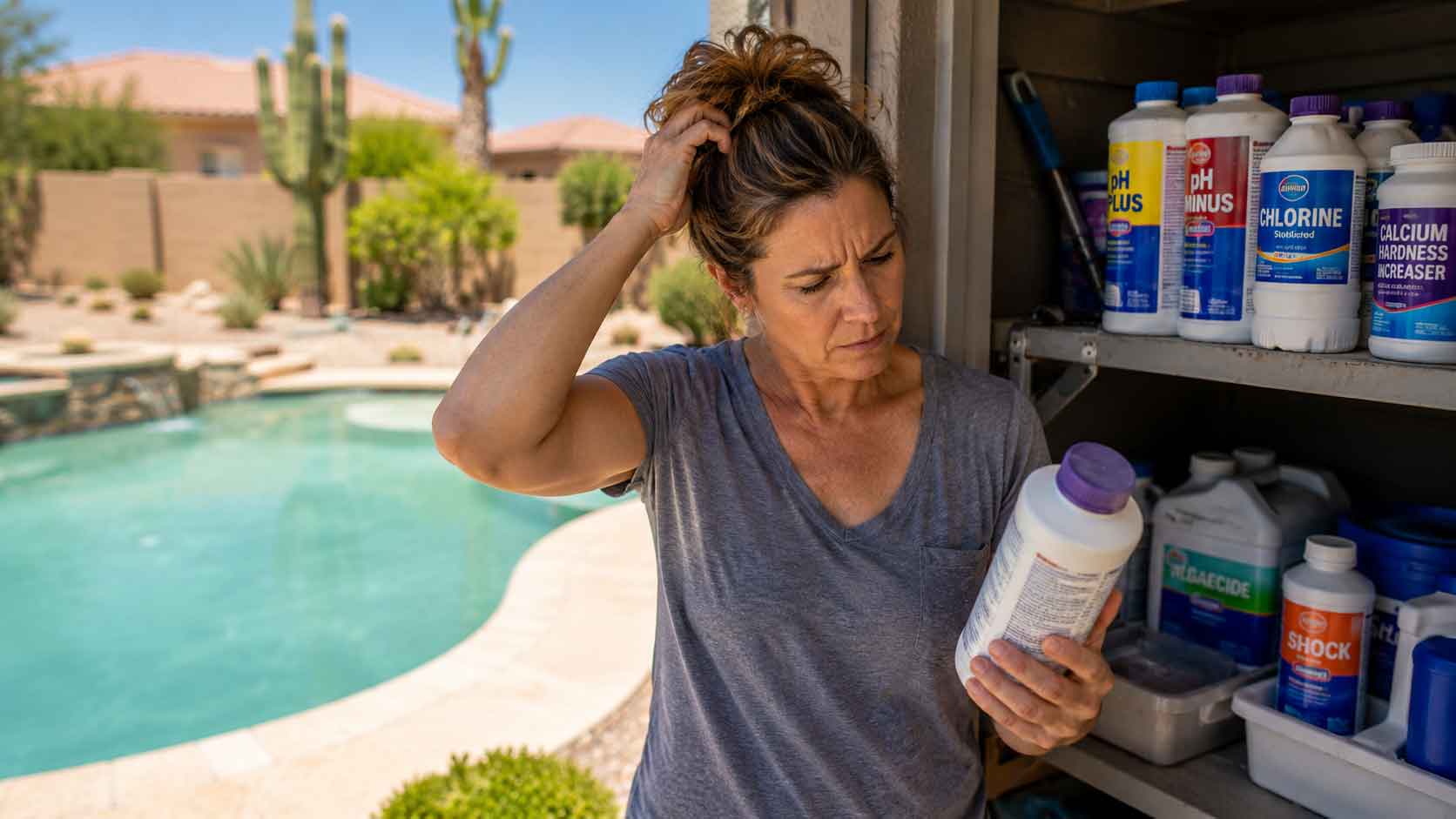
There's a big difference between maintaining pool chemistry and constantly reacting to it.
If you're testing your Phoenix pool every few days, adding acid repeatedly and wondering why the pH keeps coming right back up, the acid probably isn't the mystery. Something about the pool, its equipment, its source water or the way it's being operated is creating that demand.
That's where professional pool management can make a difference.
At Aqua Harmony Pools, we understand the challenges that come with maintaining swimming pools in the Phoenix climate. We can evaluate the entire picture — pH, alkalinity, calcium hardness, sanitizer levels, water balance, equipment operation, salt systems, automation and the condition of the pool itself — rather than simply treating whatever number happens to be high that day.
Sometimes the solution really is adding acid.
Sometimes it's changing how the pool is being managed.
And sometimes your water chemistry is giving you an early warning about a larger issue that can become considerably more expensive if it's ignored.
If you're tired of constantly chasing your pool's pH or simply want the confidence of knowing your water and equipment are being properly managed, bring in Aqua Harmony Pools as your Phoenix pool professional of choice. We'll figure out why your pool is behaving the way it is — and help keep it balanced, protected and ready to enjoy.

Phoenix pool owners often find themselves adding acid more frequently than expected. This article explains how Arizona’s hard, high-alkalinity source water, intense evaporation, aeration, salt systems, and new plaster can drive pH upward—and how proper water balance and professional pool management can prevent scaling, equipment damage, and ongoing chemistry problems.
.png)

