July 17, 2026

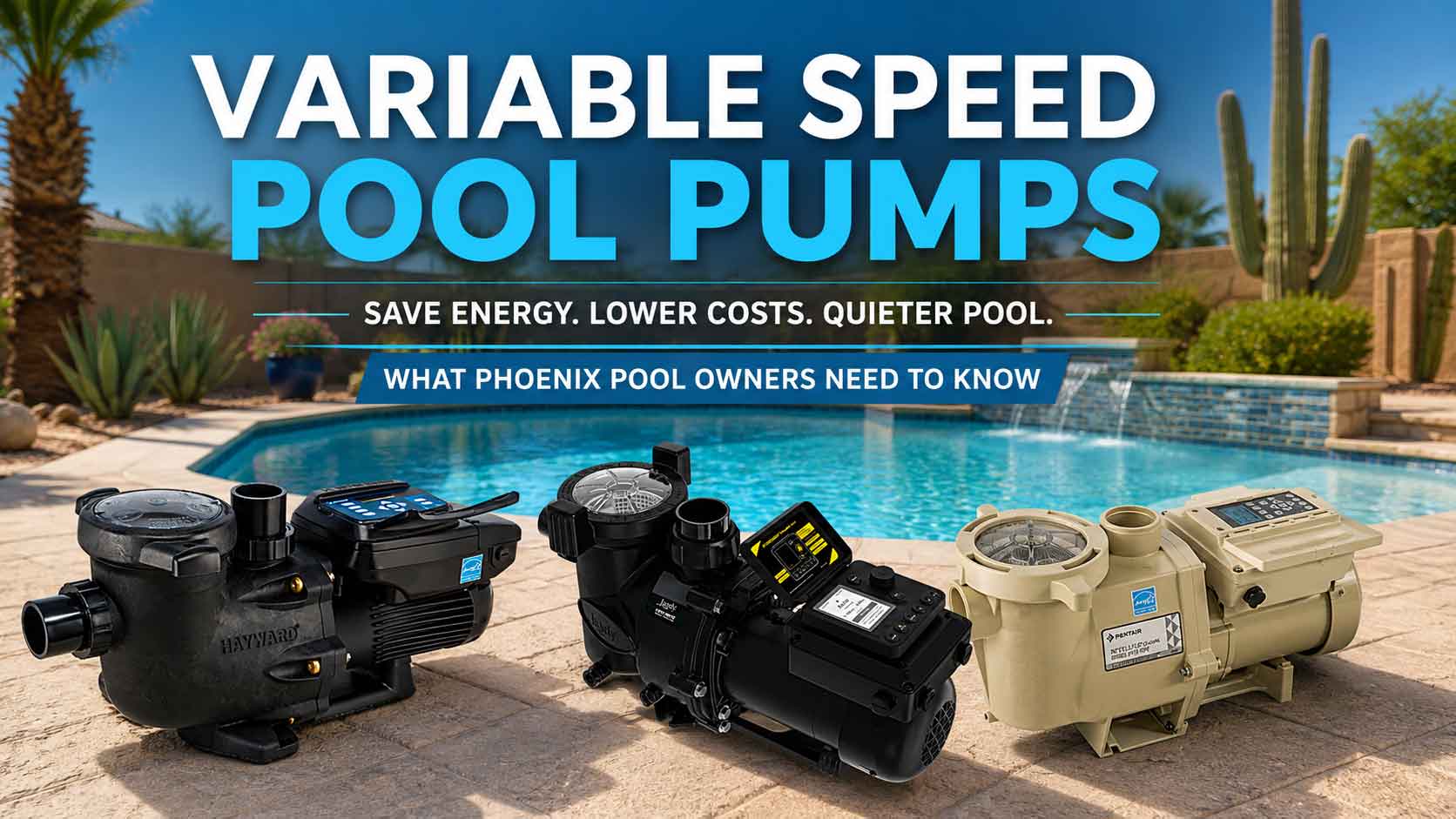
If you own a swimming pool in Phoenix, the pump is probably one of the largest electrical loads associated with your backyard. It may also be one of the easiest places to substantially reduce the cost of operating your pool.
That is why variable-speed pool pumps have gone from being considered a premium upgrade to becoming standard equipment on many modern swimming pools.
Instead of operating at one fixed speed whenever the pump is turned on, a variable-speed pump can be programmed to run at different RPMs throughout the day. That seemingly simple change can dramatically reduce electricity consumption while giving the pool owner much more control over filtration, heating, water features, cleaning systems and other equipment.
For Phoenix pool owners, where pools commonly operate throughout most or all of the year, those savings can add up quickly.
There is another reason homeowners should understand this technology: federal energy-efficiency standards have fundamentally changed the pool-pump market, and additional standards affecting replacement motors are being phased in.
There is sometimes confusion about what the federal pool-pump regulations actually require.
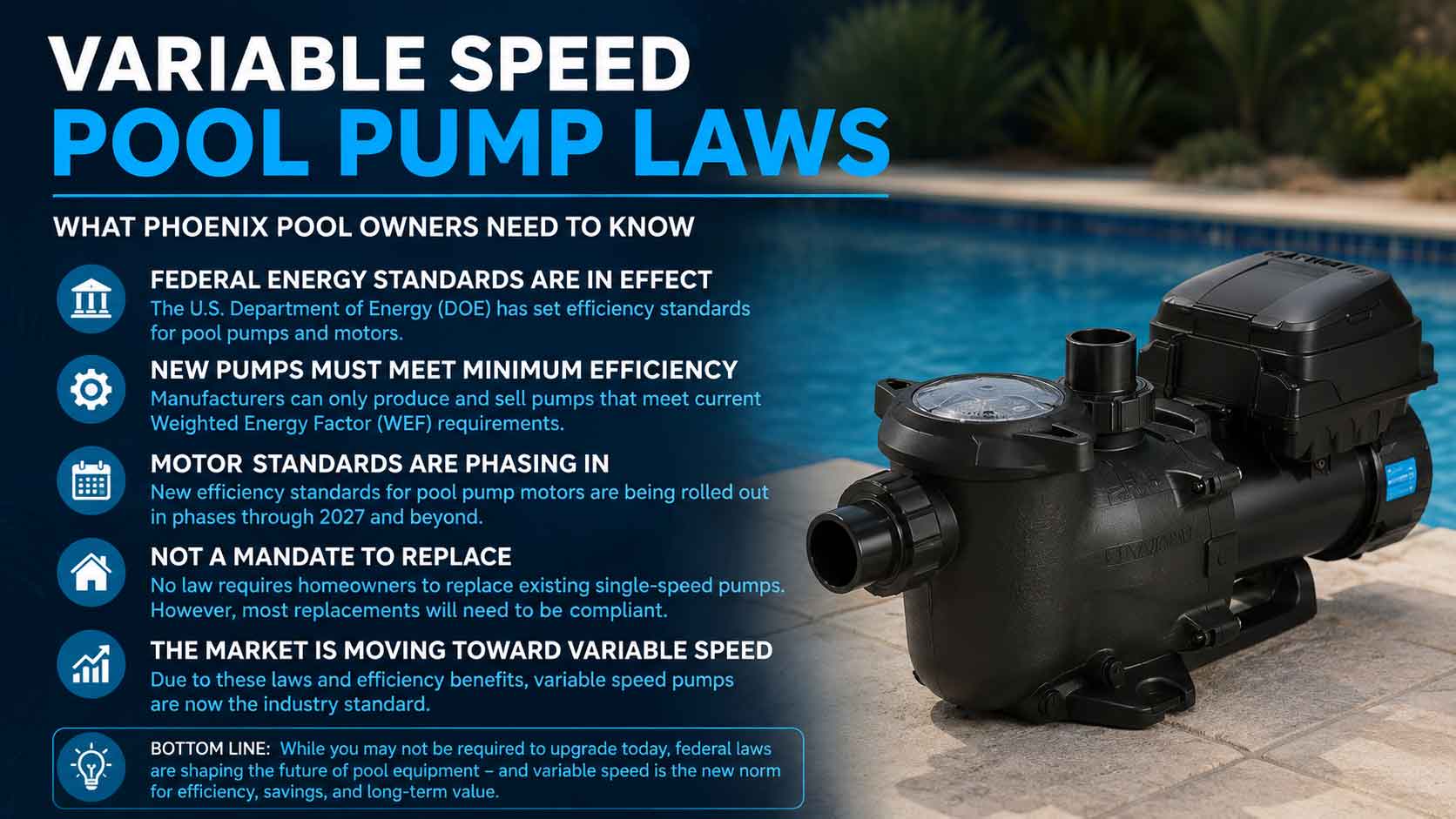
The U.S. Department of Energy established energy-conservation standards for dedicated-purpose pool pumps that effectively changed which pumps manufacturers can produce and distribute. Rather than simply declaring that "every pool must have a variable-speed pump," the regulations establish efficiency requirements using a measurement called Weighted Energy Factor, or WEF.
Those requirements have been affecting newly manufactured pool pumps since 2021.
The regulations are aimed primarily at manufacturers rather than homeowners. In other words, the government isn't requiring you to remove a functioning older pump from your Phoenix backyard simply because it is single-speed.
What has changed is the equipment available when that pump eventually needs replacement.
The Department of Energy has also adopted efficiency standards covering dedicated-purpose pool-pump motors. Standards for motors from 1.15 through 5 total horsepower became applicable in September 2025, while another compliance date affecting motors from 0.5 to less than 1.15 THP is scheduled for September 2027. DOE's motor standards include variable-speed-control requirements for covered small and standard-size motors, although DOE announced in April 2026 that it would delay certain enforcement activities involving small-size motors manufactured during part of the 2027–2029 period.
For homeowners, the takeaway is much simpler than the regulation itself:
The industry is moving decisively toward variable-speed technology.
If you have an aging single-speed pump in Phoenix, it makes sense to understand your replacement options before the old pump fails in July and suddenly turns the decision into an emergency.
The biggest misconception about pool pumps is that you need to run them at maximum speed to properly filter the pool.
Usually, you don't.
A variable-speed pump might operate at a relatively low RPM for normal filtration, increase speed when a heater or cleaner needs additional flow, run faster for a water feature or spa, and then return to an efficient filtration speed afterward.
The energy savings from reducing pump speed can be substantial.
ENERGY STAR reports major efficiency improvements from qualifying pool pumps, while manufacturers advertise savings approaching 80% to 90% compared with conventional single-speed operation under certain conditions. Pentair, for example, states that its SuperFlo VST can reduce energy consumption by up to 80%, while Hayward advertises savings as high as 90% for some variable-speed models compared with single-speed pumps. Actual savings depend heavily on the pool, plumbing, operating schedule and electricity rate.
That last point matters.
Buying a variable-speed pump doesn't automatically produce maximum savings. Programming it correctly does.
If an installer replaces your old pump and simply programs the new one to run near full speed all day, you are leaving much of the benefit of variable-speed technology on the table.
The goal is generally to determine the lowest practical flow for routine circulation and filtration, then program higher speeds only when the pool actually needs them.
There isn't one savings number that applies to every Phoenix pool.
A 12,000-gallon play pool with basic filtration is very different from a 30,000-gallon pool with an attached spa, heater, in-floor cleaning system and multiple water features.
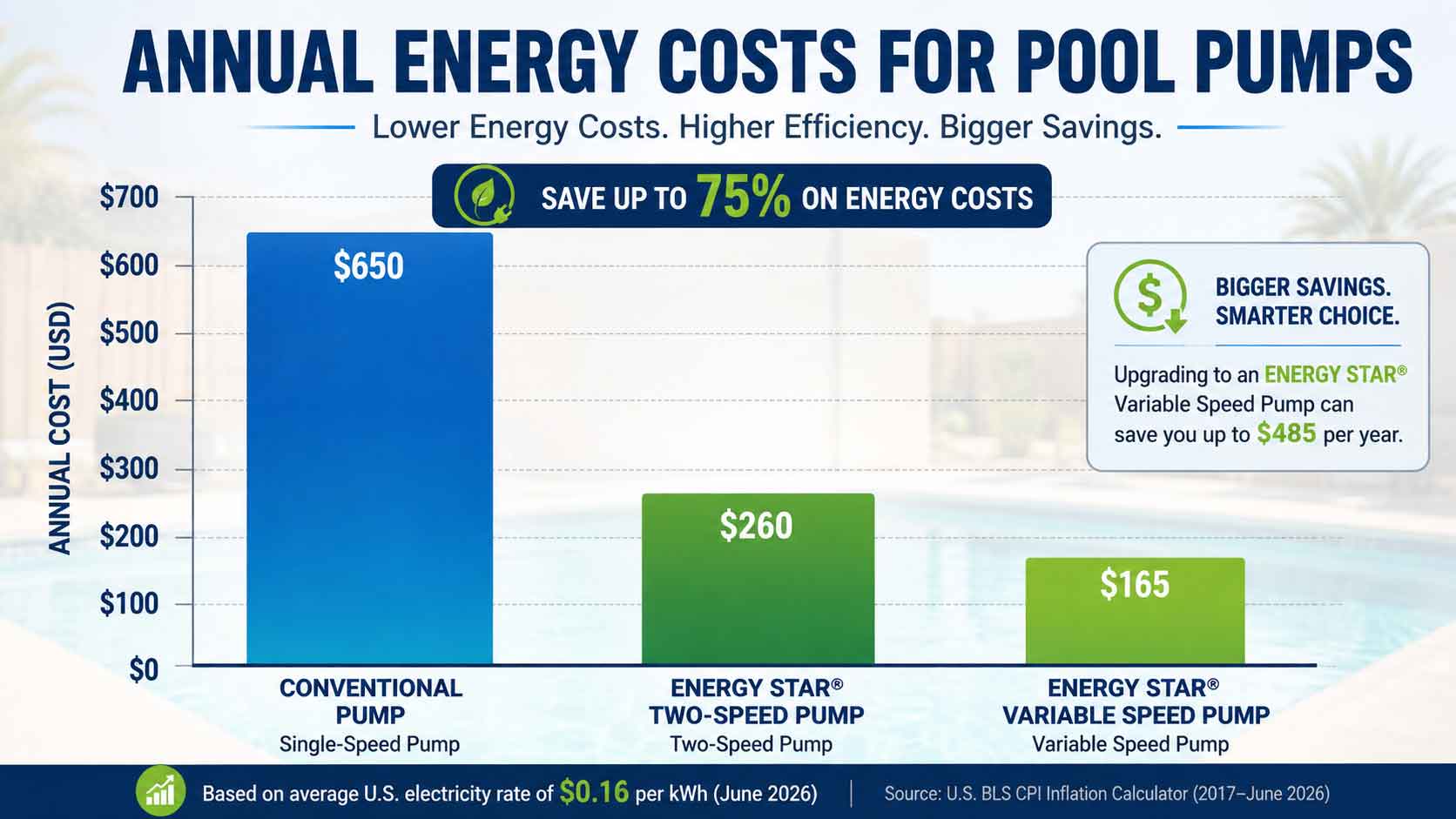
Still, replacing an older single-speed pump with a properly sized and properly programmed variable-speed pump can save hundreds of dollars per year, and high-use applications can potentially save considerably more.
Jandy, for example, has published an estimate exceeding $1,100 per year for one of its variable-speed pumps compared with a comparable 2 HP single-speed pump under its specified testing assumptions. Hayward notes that ENERGY STAR-certified variable-speed pumps can save homeowners hundreds of dollars annually depending on the region and application.
Phoenix is particularly well suited to realizing those savings because the swimming season is long and many pools circulate water throughout the year.
For a homeowner replacing an inefficient single-speed pump that has been running long hours at full RPM, the difference can be significant.
The catch is the upfront investment.
A quality variable-speed pump installation is no longer a $500 equipment swap.
Depending on pump size, automation requirements, plumbing modifications, electrical work and the condition of the existing equipment pad, a homeowner can easily be looking at $3,500 or more for quality hardware before accounting for the complete installation requirements of the project.
That sticker price deserves consideration.
But so does the operating cost of leaving an inefficient pump in service.
For many Phoenix pools with substantial annual pump runtime, a well-selected variable-speed upgrade can potentially recover its incremental cost through electricity savings in roughly two swimming seasons, particularly when replacing an older, larger single-speed pump.
That shouldn't be treated as a guarantee. Your actual ROI depends on what you are replacing, how long the old pump operates, the utility rate, the hydraulic requirements of the pool and how the new pump is programmed.
A pool professional should be able to estimate those variables before recommending equipment.
One of the biggest mistakes homeowners make is shopping for a pump based exclusively on horsepower.
More horsepower does not automatically mean a better pump.
The right pump has to match the hydraulic requirements of the pool.
Pool size matters, but so do pipe diameter, plumbing length, filter resistance, elevation changes, attached spas, heaters, solar systems, cleaners, waterfalls, deck jets, bubblers and other water features.
For a relatively straightforward Phoenix pool, an entry-level variable-speed pump may be all that is necessary. Pools with attached spas or substantial water features may require significantly more hydraulic performance.
There are also major differences in controls and automation.
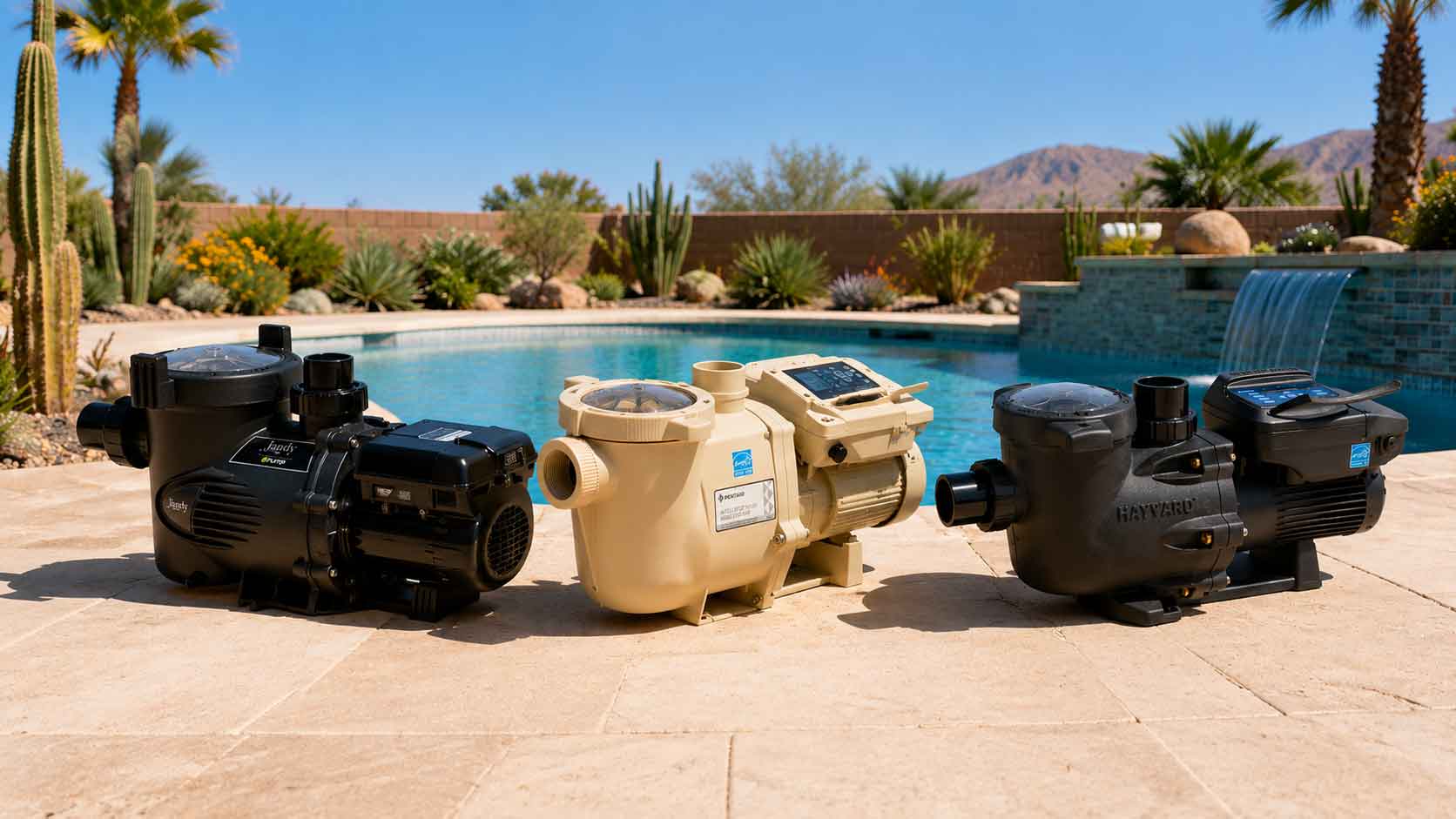
Among the three major equipment manufacturers — Pentair, Hayward and Jandy — homeowners now have several tiers to consider.
The Pentair SuperFlo VST is a strong example of a practical replacement pump for a standard residential pool. It supports 115V or 230V operation, has an onboard digital control, three programmable speeds plus an override, a 24-hour clock and RS-485 connectivity for interfacing with automation systems. Pentair positions it for standard pools and replacement applications.
Step up from there and you enter pumps such as the WhisperFlo VST, designed for applications requiring greater performance.
At the higher end is the IntelliFlo3 VSF.
This is more than a pump with a programmable keypad. The IntelliFlo3 combines variable-speed operation with flow control and built-in connectivity. Homeowners can control it through the Pentair Pool app, and certain configurations can control up to two additional pieces of equipment through an optional I/O/relay board. It is available in 1.5 and 3.0 HP versions and can also integrate with Pentair automation systems.
That makes IntelliFlo3 particularly interesting for homeowners who want some smart functionality without immediately replacing their entire equipment pad with a large automation panel.
Hayward's lineup gives homeowners a similar progression.
Its variable-speed family includes models such as the MaxFlo VS 500, Super Pump VS 700, TriStar VS 900 and TriStar VS 950. Hayward has positioned its TriStar variable-speed pumps as its flagship high-efficiency offerings.
The TriStar VS 900 and 950 include programmable speed and timer controls and can operate independently or integrate with automation.
Hayward also offers TriStar VS Omni configurations that add smart pool control directly to the package. These models can provide control through the equipment's screen, a smartphone or supported voice-enabled devices.
For larger automation projects, Hayward's Omni family provides several levels.
OmniHub is aimed primarily at adding automation to simpler existing pools. OmniPL provides greater capability for mid-range systems, while OmniLogic is the more comprehensive option for sophisticated pools and spas. These systems can control variable-speed pumps along with heaters, lighting, water features and other equipment through Hayward's automation platform.
Jandy's VS FloPro family provides several useful steps depending on the application.
The VS FloPro 1.3 HP is specifically positioned by Jandy as its most affordable variable-speed pump and makes sense for smaller pools and basic filtration applications. It is dual-voltage and uses an adjustable base that can simplify replacement installations.
The VS FloPro 1.65 HP and 1.85 HP models provide additional capacity for medium-sized pools and smaller water features. The 1.85 HP version is also available with two auxiliary relay connections.
Larger applications can move into the 2.7 HP or 3.8 HP VS FloPro, while Jandy's 3.8 HP ePump is aimed at demanding pools requiring substantial hydraulic performance.
Jandy also offers several levels of control.
The SpeedSet controller provides local programming and operation. An iQPUMP01 can provide connected control on compatible pumps, while a full AquaLink automation system with the iAquaLink app can integrate the pump with the rest of the pool equipment.
This is an important distinction for Phoenix homeowners.
You don't necessarily need a $5,000-plus automation system just because you're installing a variable-speed pump.
Many pumps can schedule their own speeds.
For example, you could program:
Morning: higher-speed circulation or cleaning
Daytime: low-speed filtration
Afternoon: increased circulation during heavy use
Evening: low-speed filtration
Water feature: high-speed manual or automated mode
For a simple pool, onboard scheduling may be perfectly adequate.
App-connected pumps add another level of convenience because speeds and schedules can be adjusted remotely.
Full automation becomes more attractive when the pool includes several pieces of equipment that need to work together.
A pool/spa combination, for example, may need to change valve positions, increase pump speed, activate a heater and adjust sanitizer settings when the homeowner selects "Spa Mode."
That is where ecosystems such as Pentair's automation platforms, Hayward Omni and Jandy AquaLink become considerably more useful.
Instead of controlling a pump, you're controlling the pool system.
Brand compatibility should be part of the purchasing decision.
If you already have Jandy AquaLink automation, there may be a strong argument for installing a compatible Jandy variable-speed pump.
The same applies to a pool already running Hayward Omni or Pentair automation.
Mixing brands is possible in certain configurations, but homeowners should not assume every pump will expose every feature through every third-party automation system.
Ask your installer specifically:
Will my existing automation communicate directly with this pump, or will it only turn it on and off?
Those are two very different things.
Direct digital communication can allow an automation system to command specific pump speeds for filtration, spa operation, heating and water features.
Simple relay control is much more limited.
The pump itself is only part of the job.
An older Phoenix pool may have been built around equipment that is 10, 20 or even 30 years old.
Replacing the pump may uncover other issues.
The new pump may have different inlet and discharge heights. Plumbing may have to be reconfigured. Old valves may be failing. Electrical service may need modification. Bonding should be inspected. Existing breakers or wiring may not be appropriate. Automation communication wiring may have to be installed.
There may also be insufficient straight pipe entering the pump, deteriorated PVC, leaking unions or an equipment pad that has been modified repeatedly over the years.
This is why comparing a pump's online price with a professional installation quote can be misleading.
You're not just paying someone to put a pump on the ground.
You're paying for the pump to be properly sized, electrically connected, hydraulically installed, bonded where required, integrated with the existing equipment and programmed correctly.
And that last step matters tremendously.
A poorly programmed $3,500 variable-speed pump can operate like a very expensive single-speed pump.
A homeowner might understandably think:
"If a 1.5 HP pump is good, I'll just buy the 3 HP model."
That isn't necessarily the right approach.
Modern variable-speed pumps can throttle down, which makes oversizing less problematic than it was with traditional single-speed equipment. But the pool's plumbing and equipment still have maximum flow limitations.
An oversized pump programmed incorrectly can create excessive velocity and pressure through old plumbing, filters, heaters and other equipment.
The better question isn't "How much horsepower can I get?"
It's:
How much flow does my pool actually require at each operating condition?
Your pool professional should be able to answer that.
Start with the pool rather than the brand.
For a straightforward pool with no spa and few water features, an entry-level variable-speed pump such as a Pentair SuperFlo VST or appropriately sized Jandy VS FloPro — or a comparable Hayward variable-speed model — may provide everything you actually need.
For a larger pool, attached spa or more demanding hydraulic system, moving into higher-capacity equipment such as the Pentair IntelliFlo3, Hayward TriStar VS series or larger Jandy VS FloPro/ePump models may make considerably more sense.
If automation is important, look at the entire equipment pad before choosing the pump.
A homeowner planning to eventually automate the heater, lights, spa, salt system and water features may be better served by selecting a pump that fits naturally into the automation ecosystem they intend to use later.
And if you don't care about controlling the pool from your phone?
That's fine too.
A properly sized pump with good onboard scheduling can still deliver the primary benefit you're looking for: moving the water your pool needs while using substantially less electricity to do it.
For Phoenix homeowners, variable-speed pumps aren't simply the latest pool-equipment trend. Federal efficiency standards have reshaped the equipment market, manufacturers are investing heavily in variable-speed and connected technology, and the economics are particularly compelling in a climate where pools operate for long periods throughout the year.
The important part is buying the right pump, not simply the most expensive one.
Before replacing an aging pool pump, have a qualified Phoenix pool professional evaluate your pool's plumbing, electrical service, existing automation, equipment requirements and actual hydraulic needs. A correctly sized and programmed variable-speed pump can lower operating costs for years. The wrong pump — or the right pump installed and programmed incorrectly — can turn an energy-saving upgrade into an expensive missed opportunity.

A practical guide for Phoenix pool owners considering a variable-speed pump upgrade, covering current efficiency regulations, energy savings, installation costs, and automation options.
.png)

